
Appraisers
Appraisal Technology
Business Growth
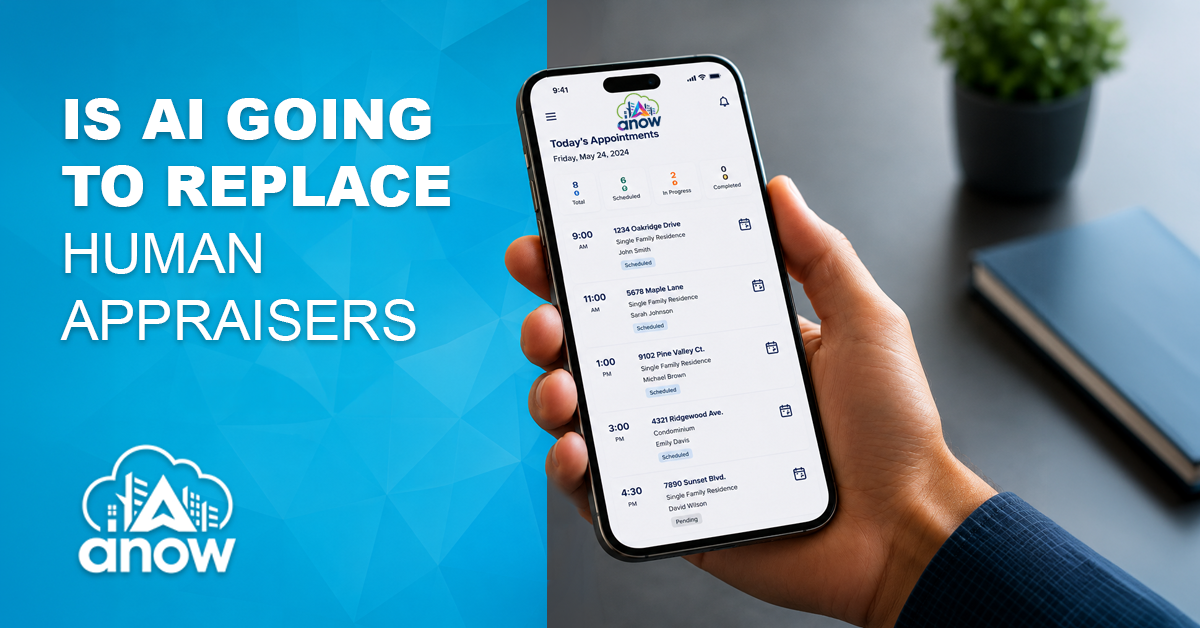

Artificial intelligence is changing nearly every corner of the real estate industry. It can analyze property records, identify market trends, recommend comparable sales, recognize features in photographs, and generate portions of a report in seconds. With these capabilities advancing quickly, it is reasonable for appraisers to ask what AI means for the future of their profession.
Is AI going to replace human appraisers?
The short answer is no. However, appraisers who use AI and modern appraisal technology may have a considerable advantage over those who resist it.
AI is unlikely to eliminate the need for qualified appraisers because an appraisal involves much more than processing property data. It requires context, interpretation, professional judgment, regulatory knowledge, and accountability. Technology can make that work faster and more consistent, but it cannot fully replicate the expertise an appraiser brings to a complex valuation assignment.
The future of appraisal is not human judgment versus artificial intelligence. It is human judgment strengthened by better technology.
At first glance, property valuation seems like an ideal candidate for automation. A property has measurable characteristics, including its location, size, age, condition, lot dimensions, and recent sales history. Comparable transactions provide additional data that can be analyzed to estimate value.
An artificial intelligence system can review far more information in a few moments than one person could reasonably examine on their own. It can identify statistical relationships, detect changes in a local market, and compare a subject property against thousands of other properties.
Automated valuation models have already demonstrated that technology can estimate property values without a traditional appraisal in certain circumstances. Fannie Mae’s modern valuation spectrum now includes value acceptance, property data collection, hybrid appraisals, desktop appraisals, and traditional appraisals. The valuation method can therefore be matched to the risk and complexity of the transaction rather than requiring the same process for every property.
That does not mean the system considers every valuation method interchangeable. In a hybrid appraisal, for example, property information may be collected by a vetted third party, but a licensed or certified appraiser still analyzes that information and develops the opinion of value. Fannie Mae describes this process as a way to streamline the physical data collection while preserving the appraiser’s role in the valuation.
Automation can estimate. An appraiser must interpret.

The most immediate value of AI is its ability to reduce the manual work surrounding an appraisal. Appraisers frequently spend a substantial amount of time gathering property information, checking records, organizing photographs, reviewing market data, and transferring information between systems.
AI can help complete many of these activities faster.
Modern appraisal software can bring together public records, prior sales, listings, market statistics, maps, property photographs, and comparable property information. AI can help identify relevant data within these sources and flag inconsistencies for further review.
For example, a system may recognize that public records show one gross living area while a prior listing reports another. It may identify a recent transfer that requires additional investigation or detect that a comparable sale differs significantly from the subject in ways that are not immediately obvious.
This does not resolve the discrepancy, but it tells the appraiser where to direct attention.
Comparable selection is one of the most discussed potential applications of AI. A system can analyze location, property characteristics, sale date, condition, quality, and other available information to suggest potentially relevant sales.
However, the mathematically closest property is not always the best comparable.
A property may sit on the opposite side of a neighborhood boundary, belong to a different school district, have a superior view, or be affected by traffic that is not properly represented in the available data. A comparable may also involve seller concessions, unusual motivations, or renovations that are difficult for an automated system to evaluate accurately.
AI can build a stronger pool of candidates. The appraiser must determine which sales actually reflect how buyers view the property.
AI can also assist with report writing, data validation, and quality review. It can identify missing fields, inconsistent statements, unsupported conclusions, or language that does not align with other information in the report.
These capabilities can help appraisers reduce revision requests and avoid preventable errors. They can also provide more time for analysis by reducing the hours spent on repetitive report production.
The opportunity is not to have AI produce an appraisal with minimal involvement. It is to give the appraiser a better set of tools for completing and reviewing the work.
Real estate data may look objective, but properties exist within complicated physical and economic environments. Two homes with nearly identical measurements can command substantially different prices because of condition, design, location, view, utility, or buyer perception.
Those differences often require human interpretation.
An automated system can process the number of bedrooms, bathrooms, and square feet associated with a property. It may not recognize that a bedroom has poor functional utility, that an addition does not match the rest of the home, or that a renovation looks impressive in photographs but uses low-quality materials.
AI also depends on the accuracy of its underlying information. Public records can be outdated. Listings can contain exaggerated descriptions. Photographs can hide defects. Property characteristics may be entered inconsistently from one source to another.
An appraiser does not simply accept the available data. The appraiser asks whether it is credible.
That distinction becomes especially important with complex properties, rural homes, mixed-use properties, unusual construction, limited comparable sales, or rapidly changing markets. These are the assignments where a model may have the least reliable information and where professional judgment carries the greatest value.
Real estate markets do not always follow clean geographic lines. A street, municipal boundary, school district, development entrance, or even a change in topography can influence buyer behavior.
An appraiser who understands the local market can recognize these divisions and explain their effect on value. AI may identify a statistical difference, but it can struggle to explain why the difference exists or whether it is meaningful for a particular assignment.
This is one reason local market competency will remain important. The more valuation tools become standardized, the more valuable credible local interpretation may become.
An appraisal is not merely a calculation. It is a professional opinion developed for a specific intended use and supported by evidence.
Appraisers are responsible for understanding the assignment, determining the appropriate scope of work, evaluating the reliability of information, applying recognized valuation methods, and communicating a supportable conclusion. They must also comply with applicable laws, professional standards, and client requirements.
An AI system cannot independently accept that professional responsibility.
Federal regulators recognize that automated models also require oversight. The federal quality-control standards for automated valuation models, effective October 1, 2025, require covered institutions to establish controls addressing confidence in model estimates, data manipulation, conflicts of interest, testing, reviews, and compliance with nondiscrimination laws. The FHFA’s final rule reinforces an important point: automated valuations are not automatically accurate, unbiased, or appropriate simply because they are produced by technology.
AI may not replace appraisers, but it will change the types of assignments appraisers receive.
Lower-risk, highly standardized properties in data-rich markets may qualify for value acceptance or another appraisal alternative. That trend began before the current surge in generative AI and will likely continue as lenders improve their collateral-risk systems.
The traditional appraisal may therefore become less common for certain routine transactions. At the same time, appraisers may handle a greater concentration of properties and assignments that require deeper analysis.
Fannie Mae has reported that hybrid appraisals can perform similarly to traditional appraisals based on its examination of risk scores, quality-control findings, and defects. That finding supports a broader valuation spectrum, but it does not remove the appraiser from the hybrid process. Instead, it separates property data collection from valuation analysis.
Freddie Mac likewise describes appraisers and appraisal reports as an integral part of the mortgage process, even as it develops additional collateral valuation methods.
The direction of the industry is therefore not complete automation. It is a more flexible process in which technology, transaction risk, property complexity, and professional judgment determine the appropriate valuation method.
The appraisers best positioned for the future will not compete with AI on speed alone. They will use technology to become faster while strengthening the skills technology cannot easily reproduce.
Appraisers should look for responsible ways to automate scheduling, order management, property research, data entry, report preparation, follow-up communication, and quality checks. Eliminating unnecessary administrative work can create more capacity without requiring the appraiser to rush the actual analysis.
This is where an integrated appraisal office platform becomes especially valuable. When assignments, calendars, communications, documents, billing, and reporting are managed in one place, the appraiser spends less time maintaining the business and more time completing revenue-producing work.
As basic data becomes easier to access, clients may place greater value on the appraiser’s ability to explain complex conditions clearly.
A strong report should do more than present a value conclusion. It should show why specific data was considered reliable, how the market was defined, why certain comparables were selected, and how the available evidence supports the final opinion.
AI may help organize that explanation, but the reasoning must come from the appraiser.
Appraisers should never assume that AI-generated information is accurate. Suggested comparables, property summaries, adjustments, market commentary, and report language must be verified against credible sources.
Confidentiality must also remain a priority. Sensitive assignment information should not be entered into a public AI tool without confirming that the tool, client requirements, and data-handling policies allow it.
AI should function as an assistant, not an unsupervised decision-maker.
AI will almost certainly take over portions of the appraisal workflow. It will gather data, identify anomalies, recommend potential comparables, draft routine language, and perform increasingly sophisticated quality checks.
That is not the same as replacing an appraiser.
A credible valuation still requires someone to determine whether the data makes sense, understand how the market views the property, recognize characteristics a model may overlook, and accept responsibility for the final analysis.
The greater opportunity is to use technology to reduce the administrative work that prevents appraisers from focusing on those responsibilities. Appraisers should not have to spend their best hours manually coordinating orders, updating clients, managing calendars, tracking payments, and moving information between disconnected systems.
That is where ANOW fits into the future of appraisal.
ANOW helps appraisal businesses manage the work surrounding the valuation from one centralized platform. Appraisers can organize assignments, coordinate schedules, communicate with clients, manage documents, monitor business performance, and streamline billing without relying on a collection of separate systems and manual processes.
ANOW is not designed to replace the appraiser’s expertise. It is designed to give appraisers more time to use it.
As AI and automation become more common throughout the mortgage industry, appraisal businesses will need to become faster and more efficient without compromising quality. The firms best prepared for that future will be the ones that use technology to strengthen their operations while keeping qualified appraisers at the center of every valuation decision.
AI can calculate patterns, organize information, and accelerate routine work. It cannot completely understand a property, interpret every local market influence, question unreliable evidence, or exercise accountable professional judgment in the same way as an experienced appraiser.
Human appraisers are not reaching the end of their profession. They are entering a more technology-enabled version of it.
With ANOW supporting the back office, appraisers can spend less time managing the process and more time completing appraisals, serving clients, and delivering valuations people can trust.
More appraisals. Less back-office work.